

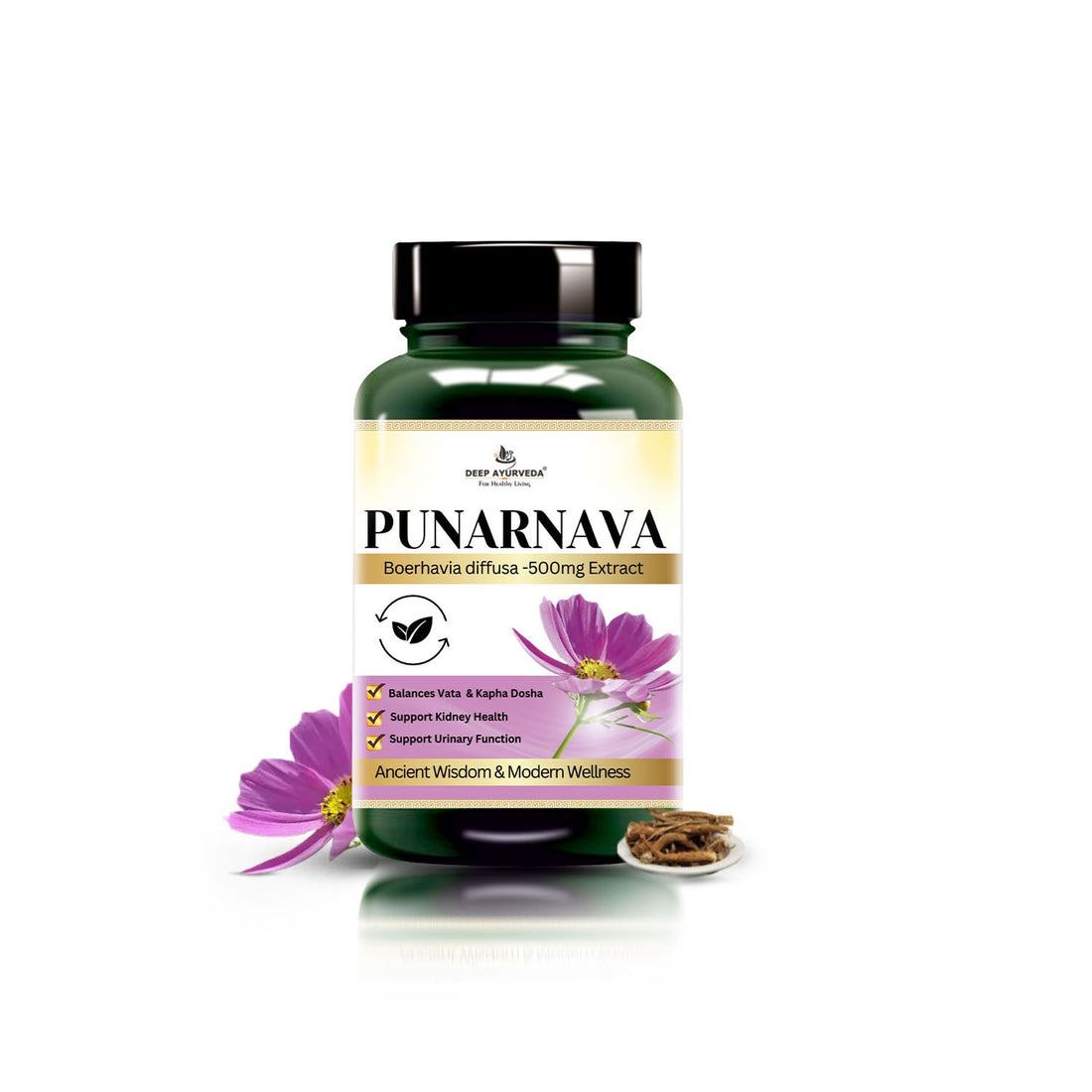
Deep Ayurveda Punarnava Capsule
✅ Supports healthy kidney and urinary function ✅ Supports healthy fluid balance ✅ Supports liver and metabolic wellness ✅ Provides antioxidant support ✅ Supports digestive health ✅ Supports joint and mobility wellness
You may have heard of Punarnava when searching for natural support for fluid balance, urinary health or general wellbeing. It is one of the better-known herbs in Ayurveda, but online information about it can be confusing. Some websites call it a kidney detox herb, others focus almost entirely on its diuretic properties, while some list a long collection of benefits without explaining where those claims come from.
The traditional Ayurvedic understanding is more nuanced.
Punarnava (Boerhavia diffusa) has been used traditionally in Ayurveda as a herb associated with fluid balance, urinary function, digestion, inflammation-related patterns and rejuvenation. Its traditional use is not based on one isolated benefit, but on the herb's qualities, actions, preparation and the individual's overall health.
Modern research has also investigated Boerhavia diffusa for several biological activities, including antioxidant and anti-inflammatory effects. However, much of this research is laboratory or preclinical work, and a 2025 review noted that important gaps remain around human efficacy, appropriate doses and duration of use.
So, what exactly is Punarnava, how is it traditionally used, how much should you take, and when should you be cautious?
Let's look at it from both an Ayurvedic and modern health perspective.
What Is Punarnava?
Punarnava is the Sanskrit name commonly used for Boerhavia diffusa, a perennial herb belonging to the Nyctaginaceae family.
The name Punarnava is often understood in relation to the Sanskrit words punar (again) and nava (new), reflecting the plant's tendency to regenerate and appear again after seasonal changes.
In Ayurveda, Punarnava is traditionally valued particularly for its relationship with mutravaha srotas (the urinary system) and shotha (swelling or oedematous conditions). The root is an important medicinal part, although other parts of the plant have also been used traditionally. India's Ministry of Ayush's E-Charak resource identifies Boerhaavia diffusa as Punarnava and lists the root as the plant part used.
One important point for anyone buying a Punarnava supplement is that Punarnava should not be treated as a generic name for any plant marketed under a similar traditional name. Checking the botanical identity and plant part helps ensure that you know what you are actually taking.
Punarnava in Ayurveda: More Than a Kidney Herb
One of the easiest ways to misunderstand Punarnava is to reduce it to the phrase kidney detox herb.
That isn't really how Ayurveda looks at it.
Traditional Ayurvedic herbal practice considers an herb according to its Rasa (taste), Guna (qualities), Virya (potency), Vipaka (post-digestive effect) and its actions within the body. These characteristics are then considered alongside the person's constitution, current imbalance, digestion, diet and other factors.
Punarnava is traditionally described as having properties that make it particularly relevant to fluid movement and elimination, which is why it appears in Ayurvedic formulations used for conditions involving swelling and urinary concerns.
What does Mutrala mean?
You will often see Punarnava described as Mutrala.
In simple terms, this refers to its traditional association with promoting urine flow.
That is different from saying that Punarnava can clean or detox a diseased kidney.
Urination is one of the body's normal routes for eliminating water and certain waste products, but increased urine output does not automatically mean that the kidneys have been detoxified.
This distinction is important when reading modern herbal marketing.
What Are the Traditional Ayurvedic Uses of Punarnava?
Rather than thinking of Punarnava as a herb with one fixed purpose, Ayurveda has traditionally used it in several contexts.
1. Supporting Healthy Fluid Balance
Punarnava is traditionally associated with Shotha, a term used in Ayurveda for swelling and related manifestations.
Its Mutrala action is one reason Punarnava has traditionally been included in preparations concerned with fluid accumulation and urinary elimination.
This is also one of the areas where modern consumers often encounter Punarnava online as a water retention herb.
However, persistent swelling should not automatically be attributed to excess water alone. Swelling can have many possible causes and may sometimes require medical assessment.
2. Supporting Urinary Function
Punarnava has an established place in traditional Ayurvedic herbal practice for supporting Mutravaha Srotas, the channels associated with urine formation and elimination.
Traditionally, this makes Punarnava relevant when an Ayurvedic practitioner is considering patterns involving:
- urinary flow
- fluid accumulation
- heaviness
- swelling
- impaired elimination
The important word here is support.
Punarnava should not be presented as a replacement for medical investigation or treatment of diagnosed kidney or urinary disease.
3. Traditional Support for Liver and Spleen Function
Punarnava also appears in Ayurvedic formulations associated with the liver and spleen.
This is an area already covered elsewhere on the Deep Ayurveda Australia website, where Punarnava is discussed alongside other traditional herbs in the context of liver health.
Rather than repeating those claims, it is useful to understand the broader Ayurvedic picture: Punarnava's traditional use is not limited to the liver.
Its traditional actions involving fluid movement and elimination are part of the reason it has been used across different Ayurvedic formulations.
4. Supporting Healthy Digestion
Ayurveda does not separate digestion from overall wellbeing.
Agni, or digestive/metabolic function, is central to Ayurvedic assessment. When digestion is poor, Ayurveda traditionally considers factors such as appetite, heaviness, bloating, bowel habits and the formation of ama (a concept describing incompletely processed material).
Punarnava has traditionally been used in certain contexts where improving elimination and supporting digestive function are considered useful together.
This is one reason it is better to understand Punarnava as part of an Ayurvedic therapeutic approach, rather than as a single-purpose supplement.
5. Supporting the Body in Inflammation-Related Patterns
Traditional use and modern research have both drawn attention to the plant's potential relationship with inflammatory processes.
Laboratory and preclinical studies have investigated constituents of Boerhavia diffusa for anti-inflammatory and antioxidant activity. A review of the Boerhavia genus identified numerous phytochemicals, including flavonoids, phenolic compounds, alkaloids and rotenoids.
But there is an important difference between:
A plant compound demonstrates biological activity in a laboratory study
and
Taking Punarnava will treat an inflammatory disease in humans.
The second statement requires appropriate clinical evidence.
6. Punarnava as a Traditional Rasayana Herb
The word Rasayana is frequently translated online as anti-ageing, but that translation is too narrow.
In Ayurveda, Rasayana refers to a broader approach to supporting health, vitality, nourishment and resilience.
Punarnava's traditional reputation for renewal is reflected in its name and its inclusion in certain Ayurvedic rejuvenative approaches.
This doesn't mean that taking Punarnava will literally make the body young again. Instead, the traditional concept is better understood as supporting the body's ability to maintain healthy function and vitality.
Punarnava Benefits: What Does Modern Research Suggest?
This is where we need to slow down and separate traditional Ayurveda from modern evidence.
Research into Boerhavia diffusa has explored a range of biological effects. A recent 2025 review identified more than 130 reported phytochemicals in B. diffusa and discussed research into antioxidant, anti-inflammatory, antimicrobial and other pharmacological activities. However, the authors also highlighted the need for better research into mechanisms, standardisation and safety.
Antioxidant activity
Some constituents of Boerhavia diffusa have demonstrated antioxidant activity in experimental research.
Antioxidants are compounds that can help neutralise reactive molecules known as free radicals.
This is interesting scientifically, but laboratory antioxidant activity should not be interpreted as proof that Punarnava prevents a particular disease.
Anti-inflammatory activity
Preclinical research has also investigated the anti-inflammatory properties of Boerhavia diffusa.
This may help explain why the plant has attracted scientific interest alongside its long history of traditional use.
However, more high-quality human research is needed before specific therapeutic conclusions can be made.
Urinary and diuretic activity
Punarnava's traditional Mutrala action has also been investigated experimentally.
This is perhaps the most relevant connection between its traditional reputation and modern research: researchers have explored whether preparations of Boerhavia diffusa can influence urine output and fluid handling.
Again, research interest does not equal a proven treatment for kidney disease.
Liver-related research
Preclinical studies have explored potential hepatoprotective effects of Boerhavia diffusa, which is consistent with its traditional inclusion in some liver-related Ayurvedic formulations.
But people with diagnosed liver disease should not self-treat with Punarnava based on these findings.
The evidence in perspective
The most honest summary is:
Punarnava has a long history of traditional Ayurvedic use and promising pharmacological research, but modern evidence does not yet justify treating it as a proven cure for specific diseases.
That is a much more useful message for someone trying to make an informed health decision.
Punarnava for Kidney Health: Traditional Use vs Kidney Detox
The phrase kidney detox is everywhere in herbal marketing, so it deserves a closer look.
Your kidneys already perform sophisticated filtration and regulation every day. They help regulate fluid and electrolyte balance and remove waste products through urine.
Punarnava's traditional Ayurvedic role is different: it is associated with Mutrala action and urinary elimination.
So rather than saying:
Punarnava detoxes your kidneys,
a more accurate Ayurvedic explanation is:
Punarnava has traditionally been used to support urinary elimination and healthy fluid balance.
That wording respects the traditional use without making a medical claim that the available evidence cannot support.
If someone has persistent swelling, blood in the urine, significant changes in urination, severe flank pain or known kidney disease, they should seek appropriate medical advice rather than attempting to manage the problem with an herbal supplement alone.
How Is Punarnava Traditionally Taken?
Punarnava can be found in several forms, and this matters because the dose of one preparation cannot simply be transferred to another.
Punarnava Churna
Punarnava may be prepared as a traditional herbal powder, or Churna.
The amount used traditionally can vary according to the preparation, purpose and individual assessment.
Punarnava Kwatha
A Kwatha is a traditional Ayurvedic decoction prepared by processing herbs with water.
A decoction is not equivalent to simply taking the same herb in powdered form because the preparation method affects what compounds are extracted.
Punarnava Extract
Modern supplements may use a concentrated extract.
This is particularly important when reading labels.
For example, a 10:1 extract is not the same thing as 1 gram of ordinary herb powder. The extraction ratio indicates that a quantity of starting herbal material was used to produce a smaller quantity of extract, although the ratio alone does not tell you the complete chemical profile or potency of the finished product.
The Australian TGA also notes that different extraction methods and solvents can alter the characteristics of herbal ingredients, which is why the type and preparation of a herbal extract matter.
Punarnava Dosage: How Much Should You Take?
There is no single universal Punarnava dosage that is appropriate for everyone.
The appropriate amount can depend on:
- the form being used
- powder vs extract
- extract concentration
- the plant part
- the person's age
- individual constitution and Ayurvedic assessment
- the intended purpose
- other medicines or supplements being taken
- existing health conditions
This is particularly important with concentrated extracts.
For Deep Ayurveda's Australian Punarnava Vegan Capsule, the product page provides its own preparation-specific directions, based on its 10:1 extract. Those directions should be followed for that particular product rather than treating them as a universal dosage for every Punarnava preparation.
Is Punarnava Safe?
Punarnava has a long history of traditional use, but traditional use does not mean that every preparation is automatically suitable for every person.
The TGA makes the same broader point about complementary medicines in Australia: a product being described as natural does not automatically make it risk-free, and complementary medicines can cause side effects or interact with medicines.
Possible suitability concerns are particularly relevant for people who:
- take prescription medicines
- use medicines that affect fluid balance or blood pressure
- have kidney or liver conditions
- are pregnant or breastfeeding
- are preparing for surgery
- are taking several herbal products at the same time
If you are taking regular medication, it is sensible to tell your doctor, pharmacist or appropriately qualified practitioner about all herbal products and supplements you use.
What About Punarnava Side Effects?
There is not enough high-quality human evidence to provide a simple, definitive list of side effects for every Punarnava preparation.
This is one reason dosage and preparation matter.
Taking an inappropriate amount, using a concentrated extract without guidance, combining several products with overlapping effects, or using a supplement despite an underlying health condition can change the risk profile.
Stop using a product and seek professional advice if you experience an unexpected or concerning reaction.
And if you have a diagnosed medical condition, don't replace prescribed treatment with Punarnava without discussing it with your healthcare professional.
Who Should Be More Careful With Punarnava?
Extra caution is appropriate if you:
Have kidney or urinary problems
Punarnava is traditionally associated with urinary function, but diagnosed kidney disease requires individual medical assessment.
Take medicines regularly
Herbal products may interact with medicines, and the risk can depend on the particular preparation and dose.
Take diuretics or medicines affecting fluid balance
Because Punarnava is traditionally associated with urine output, combining it with medicines that have similar physiological effects should be discussed with a healthcare professional.
Are pregnant or breastfeeding
Safety information may be insufficient for some herbal preparations, so professional guidance is preferable.
Are preparing for surgery
Tell your healthcare team about herbal medicines and supplements before surgery. The TGA specifically advises consumers to disclose complementary medicines before procedures because some products can interact with medicines or affect procedural risks.
Punarnava and Australian Herbal Medicine: What Should You Look For?
If you're buying Punarnava in Australia, don't judge a product purely by attractive packaging or a long list of health claims.
Look for a product with:
- a clearly stated botanical name
- the plant part identified
- clear ingredient quantities
- transparent dosage instructions
- manufacturer information
- appropriate Australian regulatory details
- clear warnings and directions
The TGA states that complementary medicines supplied in Australia generally need to be included in the Australian Register of Therapeutic Goods (ARTG), and consumers can look for an AUST number on the label.
This is especially useful when comparing products purchased online, because products imported from overseas websites may not have the same regulatory oversight as products legally supplied in Australia.
Punarnava vs Other Ayurvedic Herbs
One common mistake is to treat all Ayurvedic herbs associated with urinary or fluid balance as interchangeable.
They aren't.
For example, Punarnava and Gokshura have different traditional profiles and are used differently within Ayurvedic practice. Likewise, Triphala has a much broader traditional role and shouldn't simply be substituted for Punarnava because both are sometimes marketed for detox.
Ayurveda traditionally chooses herbs based on the individual and the pattern being addressed, rather than simply selecting whichever herb has the longest list of benefits online.
This is an area where personalised Ayurvedic guidance can be more useful than self-prescribing.
Punarnava in Classical Ayurvedic Formulations
Punarnava is also used as an ingredient in traditional Ayurvedic formulations rather than always being consumed as a standalone herb.
One example is Punarnavadyarishta, a classical formulation associated with Punarnava.
This is important because a classical formulation containing Punarnava may have a different purpose, composition and dosage from a standalone Punarnava powder or extract.
So if you come across the same herb in different Ayurvedic products, don't assume that they are therapeutically interchangeable.
A Simple Way to Think About Punarnava
If we strip away the modern marketing language, Punarnava can be understood through four key ideas:
Fluid balance
→ Traditionally associated with helping the body manage and eliminate excess fluid.
Urinary function
→ Traditionally recognised for its Mutrala action.
Whole-body support
→ Used within broader Ayurvedic approaches involving digestion, elimination and specific constitutional patterns.
Rejuvenation
→ Associated traditionally with Rasayana concepts of maintaining vitality and healthy function.
This is a more accurate picture than simply calling Punarnava a kidney detox herb.
When Should You See a Health Professional?
Don't assume that swelling, urinary changes or persistent fatigue are simply signs that you need an Ayurvedic herb.
Seek appropriate medical assessment if you experience symptoms such as:
- unexplained or persistent swelling
- blood in the urine
- major changes in urine output
- severe or persistent flank pain
- yellowing of the skin or eyes
- unexplained ongoing weight changes
- severe or worsening symptoms
Ayurvedic herbs can be part of a complementary wellness approach, but they should not delay diagnosis or necessary medical treatment.
Final Thoughts
Punarnava is a valued Ayurvedic herb traditionally used to support fluid balance, urinary function, digestion and overall vitality. Its benefits should be understood in the context of individual needs, preparation and dosage. For safe and appropriate use, especially alongside medicines or existing health concerns, professional guidance is recommended.
Frequently Asked Questions About Punarnava
What is Punarnava used for in Ayurveda?
Punarnava (Boerhavia diffusa) is traditionally used in Ayurveda for supporting urinary function, fluid balance and certain inflammatory or swelling-related patterns. It is also included in various classical formulations.
What is the botanical name of Punarnava?
The commonly recognised botanical name is Boerhavia diffusa.
Is Punarnava a kidney detox herb?
Kidney detox is mainly a modern marketing expression. In Ayurveda, Punarnava is traditionally described as Mutrala and associated with urinary elimination and fluid balance. This should not be confused with treating or cleansing a diseased kidney.
What is the traditional dosage of Punarnava?
Dosage depends on whether you are using powder, decoction, fresh preparation, extract or a classical formulation. A concentrated extract should not be dosed in the same way as ordinary herb powder.
Can Punarnava be taken every day?
Daily use may be appropriate in some traditional or product-specific contexts, but suitability depends on the preparation, dose and individual. If you take medicines or have an existing health condition, seek professional advice.
Is Punarnava the same as Boerhavia diffusa?
Yes. Boerhavia diffusa is the botanical species commonly identified as Punarnava.
Can I take Punarnava with prescription medicines?
It depends on the medicine and the Punarnava preparation. Because herbal medicines can interact with conventional medicines, discuss regular use with your doctor or pharmacist.
Is Punarnava powder better than capsules?
Not necessarily. Powder and capsules are different delivery formats, and capsules may contain either powdered herb or a concentrated extract. Compare the botanical identity, plant part, preparation and amount rather than judging by format alone.
Who should avoid taking Punarnava?
People with significant medical conditions, those taking regular medicines, pregnant or breastfeeding women, and anyone preparing for surgery should seek appropriate professional advice before using Punarnava.


